Introduction
If you’ve ever felt stuck in a career that doesn’t excite you—or wondered whether you could pivot into one of the fastest-growing tech fields—then DevOps might be the path you’ve been looking for.
DevOps is more than just a buzzword. It’s a modern approach to building and running software that emphasizes speed, collaboration, and reliability. Instead of developers writing code in isolation and IT teams deploying it weeks later, DevOps brings the two worlds together. The result? Faster releases, fewer errors, and happier customers.
Why is this important for you as a career switcher? Because companies across the U.S. are scrambling to hire DevOps professionals. According to the U.S. Bureau of Labor Statistics, roles related to software and systems administration (which include DevOps) are expected to grow by 15% between 2021 and 2031—much faster than the average for other occupations. Tech giants like Amazon, Microsoft, and Google, as well as countless startups, rely heavily on DevOps practices to keep their products running smoothly.
But here’s the best part: DevOps is accessible, even if you’re not from a traditional tech background. While it does involve learning some technical tools and processes, the field values problem-solvers, communicators, and adaptable thinkers—skills that professionals from non-tech fields already bring to the table.
In this guide, we’ll break down everything you need to know about becoming a DevOps engineer: what the role involves, the skills required, how to transition from a non-tech background, and the salary potential that makes this switch worthwhile. By the end, you’ll have a clear roadmap to decide whether DevOps is the right next step in your career journey.
What is DevOps?
At its core, DevOps is a cultural and technical movement that bridges the gap between software development (Dev) and IT operations (Ops). Instead of working in silos, DevOps encourages collaboration between developers, system administrators, quality assurance teams, and even security experts.
The goal? Deliver software faster, with fewer errors, and keep it running reliably in production.
Here are the key principles that define DevOps:
- Collaboration & Communication
- Teams work together across the entire software lifecycle. Developers don’t just “throw code over the wall” to operations anymore.
- Automation
- From testing to deployment, much of DevOps relies on automated pipelines. This reduces manual effort and ensures consistency.
- Continuous Integration (CI) & Continuous Delivery (CD)
- Code is integrated and tested regularly (CI).
- Deployments happen frequently and smoothly (CD).
- Monitoring & Feedback
- Applications are constantly monitored in real time, and feedback loops ensure quick fixes and improvements.
Why is DevOps so popular?
- Companies want to release products faster to keep up with competition.
- Customers expect reliable and always-available digital services.
- Cloud computing platforms like AWS, Azure, and Google Cloud make DevOps practices easier to adopt at scale.
What Does a DevOps Engineer Do?
If you’re new to tech and hearing the term DevOps for the first time, you might be wondering: What exactly does a DevOps Engineer do? Think of them as the bridge between software development and IT operations. Instead of teams working in isolation, DevOps Engineers create a culture and system where building, testing, and releasing software can happen faster, safer, and more reliably.
A DevOps Engineer’s day-to-day work is never quite the same. Here are some of the core responsibilities:
- Automation & CI/CD Pipelines: They design systems so that code moves from developer laptops to live production with minimal manual steps. This means using tools like Jenkins, GitHub Actions, or GitLab CI/CD to build automated pipelines.
- Cloud Infrastructure: Many companies run on AWS, Azure, or Google Cloud, and DevOps Engineers manage these environments to make them scalable and cost-efficient.
- Monitoring & Reliability: It’s not just about deploying code — it’s about making sure apps stay up and running. DevOps Engineers use tools like Prometheus, Grafana, or Datadog to keep an eye on system health.
- Collaboration & Problem-Solving: They work closely with developers, testers, and security teams, acting as a problem-solver across departments.
Unlike a traditional system administrator who focuses only on servers, or a developer who only writes code, a DevOps Engineer wears multiple hats. The role combines coding, infrastructure management, and process optimization.
That’s also why companies are so eager to hire DevOps professionals: they reduce bottlenecks, speed up delivery, and lower costs. For someone switching into tech, this makes DevOps a particularly impactful and rewarding path.
Why Choose DevOps as a Career?
If you’re considering a switch into tech, you probably want to know whether DevOps is a smart long-term choice. The answer is yes — and here’s why:
1. A Career in High Demand
Organizations across every sector — finance, healthcare, e-commerce, government — are adopting DevOps practices. According to the 2023 Puppet State of DevOps Report, over 83% of businesses are using DevOps in some form. That translates to tens of thousands of open positions across the U.S. and globally.
The U.S. Bureau of Labor Statistics also projects much faster-than-average job growth for software-related roles, which includes DevOps functions. Put simply, demand isn’t slowing down anytime soon.
2. Competitive Salaries
Compensation is one of the biggest motivators for a career switch, and DevOps doesn’t disappoint. In the U.S., salaries typically range from $105,000 to $145,000, while senior engineers and architects often command $160,000+ (sources: Glassdoor, Indeed, 2024). With many remote opportunities available, you’re not tied to Silicon Valley to earn top pay.
3. Career Flexibility & Growth
A DevOps role is rarely the end of the road — it’s often a gateway. Many engineers move into related positions like:
- Site Reliability Engineer (SRE)
- Cloud Architect
- Engineering Manager
That means you’re not just stepping into a stable career but also building a launchpad for leadership roles.
4. A Role That Stays Interesting
Unlike some tech jobs where tasks can feel repetitive, DevOps keeps you engaged. You might spend one day automating deployments, another fine-tuning cloud costs, and another solving a tricky reliability issue. It’s a mix of coding, problem-solving, and innovation.
5. Industry Recognition
Because DevOps touches nearly every aspect of modern software delivery, professionals in this space often become highly visible inside their organizations. That visibility can lead to faster promotions, leadership opportunities, and cross-functional influence.
What Skills Do You Need to Become a DevOps Engineer?
Switching into DevOps doesn’t mean you need to become an expert in everything overnight. The role blends multiple areas — coding, cloud, automation, and teamwork — so the best approach is to build your skill set step by step. Let’s break down the core skills employers look for and why they matter.
1. Foundational Knowledge in Software Development
You don’t need to be a full-time software engineer, but understanding how developers build applications is essential. This includes:
- Basic programming (Python, Bash, or Go are common in DevOps).
- Version control with Git — collaborating through GitHub or GitLab is standard everywhere.
This foundation allows you to understand the code you’ll be deploying and automating.
2. System Administration & Operating Systems
DevOps Engineers often manage environments where applications live. Having a good grasp of Linux and Windows servers is key. Tasks may include:
- Setting up environments.
- Troubleshooting performance issues.
- Managing security configurations.
Linux is especially popular in cloud and containerized environments, so it’s worth making it a strong focus.
3. Cloud Platforms (AWS, Azure, GCP)
Nearly every organization now runs infrastructure on the cloud. Employers frequently list cloud knowledge as a must-have skill. Examples include:
- AWS (Amazon Web Services): The most widely used platform.
- Microsoft Azure: Popular with enterprises.
- Google Cloud Platform (GCP): Favored in data-heavy and startup environments.
Learning cloud basics such as provisioning servers, setting up storage, and configuring security groups will immediately boost your resume.
4. CI/CD (Continuous Integration & Continuous Deployment)
At the heart of DevOps is automation — moving code from development to production quickly and reliably.
- Tools like Jenkins, CircleCI, GitHub Actions, or GitLab CI are used to build pipelines.
- You’ll learn how to automate testing, integration, and deployment, so releases can happen daily (instead of every few months).
Employers love candidates who can show they’ve built or managed a CI/CD pipeline — even a simple one for a personal project.
5. Containers & Orchestration (Docker & Kubernetes)
Modern applications don’t always run directly on servers. Instead, they’re packaged into containers that can run anywhere.
- Docker lets you bundle applications with all their dependencies.
- Kubernetes (K8s) orchestrates thousands of these containers, ensuring they scale and stay available.
This skill set is considered one of the most in-demand in DevOps.
6. Infrastructure as Code (IaC)
Instead of manually clicking through cloud dashboards, DevOps Engineers use code to create and manage infrastructure.
- Tools like Terraform or AWS CloudFormation make this possible.
- It’s faster, less error-prone, and easily repeatable.
IaC has become a standard across companies because it saves time and keeps environments consistent.
7. Monitoring & Observability
Once software is deployed, keeping it healthy is critical. DevOps Engineers learn tools such as:
- Prometheus & Grafana (for metrics and dashboards).
- ELK Stack (Elasticsearch, Logstash, Kibana) (for logs).
- Datadog, Splunk, or New Relic (popular enterprise monitoring solutions).
These skills help spot issues before users notice, which is highly valued in high-traffic industries like finance and e-commerce.
8. Soft Skills: The Hidden Strength
Technical skills alone won’t make you successful in DevOps. You’ll also need:
- Collaboration: Working across developers, testers, and operations.
- Problem-solving mindset: Thinking through bottlenecks and creative fixes.
- Adaptability: Tech evolves fast, and so does DevOps.
Many career switchers already excel at these soft skills, especially if they come from fields like project management, education, healthcare, or business. That’s an advantage you can lean on.
How to become a devops engineer?, the answer we all have been waiting for !
If you’re curious about becoming a DevOps Engineer — whether you’re starting fresh, switching from another tech role, or coming from a non-technical background — this guide will walk you through everything you need to know.
Here’s a practical roadmap you can follow if you’re serious about becoming a DevOps Engineer.
Step 1: Learn the Basics of Software Development
The foundation of DevOps lies in understanding how software is built and shipped. Start small by learning Git for version control and getting comfortable with basic coding. You don’t need to be a professional software developer, but knowing how applications move from code to deployment will make every later step much easier. Try building small projects — something as simple as a personal website or a to-do list app. Running and debugging your own code gives you confidence that will pay off later.
Step 2: Master Linux and Scripting
Almost everything in DevOps runs on Linux. Spend time learning how to navigate the command line, understand file systems, manage processes, and set permissions. Once you’re comfortable, move on to scripting. Writing Bash or Python scripts to automate repetitive tasks will save you time and help you think in terms of automation, which is at the heart of DevOps.
Step 3: Learn Networking and Cloud Basics
DevOps isn’t just about code — it’s also about infrastructure. At this stage, focus on understanding how servers talk to each other. Learn the basics of networking: DNS, HTTP/HTTPS, IP addresses, and load balancers. Then, start experimenting with cloud platforms. AWS is the most widely used, and you can start with their free tier to spin up servers, deploy an application, or set up a simple database. This will give you hands-on exposure without burning your wallet.
Step 4: Get Comfortable with CI/CD Tools
One of the biggest goals in DevOps is to automate software delivery. This is where CI/CD (Continuous Integration and Continuous Deployment) tools come in. Play around with Jenkins, GitHub Actions, or GitLab CI/CD to set up simple pipelines. Even automating a basic build and deployment process will give you the “aha” moment of seeing how DevOps speeds things up.
Step 5: Work with Containers and Kubernetes
Modern applications often run inside containers. Start with Docker, where you’ll package applications into containers that can run anywhere. Once you understand that, move on to Kubernetes. Kubernetes might seem intimidating at first, but you can practice with Minikube on your laptop or a small cluster in the cloud. The main idea here is learning how to scale and manage containerized applications.
Step 6: Explore Infrastructure as Code
Instead of manually creating servers and environments, DevOps relies on Infrastructure as Code (IaC). Learn Terraform to provision infrastructure automatically, and Ansible to configure servers without having to log into each one. This approach ensures that environments are consistent and repeatable, which is a huge advantage in large systems.
Step 7: Set Up Monitoring and Logging
Building and deploying applications is only half the story — keeping them healthy is the other half. Learn how to set up monitoring systems using tools like Prometheus and Grafana. They’ll help you keep an eye on performance, while logging tools like the ELK Stack (Elasticsearch, Logstash, and Kibana) help track down issues when something goes wrong. Employers love to see that you can not only deploy but also maintain systems in real life.
Step 8: Get Involved in Real Projects
The best way to learn DevOps is by doing. Apply your skills in real-world projects, even if they’re personal or open-source contributions. Try building a CI/CD pipeline for one of your own applications, or contribute to DevOps-related projects on GitHub. These hands-on experiences not only solidify your knowledge but also give you something tangible to showcase to employers.
Step 9: Consider Certifications
While not mandatory, certifications can be helpful — especially if you’re switching careers and need a way to prove your knowledge. Some of the most popular ones are AWS Certified DevOps Engineer, Certified Kubernetes Administrator (CKA), Azure DevOps Engineer Expert, and Google Professional DevOps Engineer. They provide structure to your learning and add credibility to your resume.
Step 10: Build a Portfolio and Start Applying
Finally, bring everything together. Create a GitHub profile where you host your projects, pipelines, and automation scripts. Write short case studies about how you solved specific problems — like automating deployments or setting up monitoring. When you start applying for jobs, these real examples will stand out more than just listing tools on your resume. Look for internships, junior cloud roles, or entry-level DevOps/SRE positions to get your foot in the door.
It’s about building a mindset of automation, collaboration, and continuous improvement. If you start with the basics, layer your skills step by step, and work on real projects, you’ll have a portfolio that speaks louder than any certification.
Why DevOps is a Great Career Switch Option?
If you’ve been thinking about switching careers and eyeing the tech industry, chances are you’ve come across the word DevOps more than once. It might sound like another tech buzzword, but trust me — DevOps is more than just jargon. It’s one of the most exciting, flexible, and rewarding paths you can take if you want to break into tech, even if your background isn’t in programming.
So, why is DevOps such a great career switch option? Let’s unpack it.
First, the demand is undeniable. LinkedIn’s jobs data shows DevOps roles among the fastest-growing tech jobs worldwide, and the U.S. Bureau of Labor Statistics projects steady, above-average growth in IT operations roles throughout this decade. Translation? Companies are hiring, and they’re hiring a lot.
But here’s the part most people overlook: DevOps values transferable skills. Maybe you’ve been in project management, operations, customer service, or even a non-technical role like marketing. Skills like problem-solving, communication, and the ability to manage complex projects actually matter in DevOps. You don’t have to reinvent yourself completely; you just have to learn how to combine those strengths with new technical skills.
And the cherry on top? DevOps is a career that lends itself perfectly to remote work. Teams are spread across time zones, collaborating through tools like Slack, GitHub, and cloud platforms. If flexibility and global opportunities appeal to you, DevOps checks those boxes.
Can You Become a DevOps Engineer Without Coding?
Short answer: yes.
Longer answer: you’ll need some scripting, but you don’t have to be a software developer. Think of it this way — DevOps engineers don’t sit around writing huge applications from scratch. Instead, they automate tasks, manage infrastructure, and keep systems running smoothly. A bit of Python or Bash goes a long way.
Plenty of people break into DevOps by focusing on tools first. Start with Docker, Jenkins, Terraform, and Kubernetes. As you get comfortable, you’ll naturally pick up the level of coding you actually need.
Salary and Career Growth in DevOps
One of the biggest reasons people switch into DevOps is the earning potential. Unlike some career paths where it takes years to see decent pay, DevOps roles are well-compensated from the start — and the growth is steady as you gain experience.
US Salary Ranges

- Entry-level DevOps Engineer (0–2 years): Typically around $70,000–$95,000 per year. This is where you’re just starting out, probably working on pipelines, basic cloud deployments, and learning the ropes.
- Mid-level (3–5 years): Once you’ve got some real projects under your belt, salaries jump to the $100,000–$130,000 range. By this stage, you’re usually managing larger systems and mentoring juniors.
- Senior Engineer (5–8 years): Expect anywhere between $130,000–$160,000 depending on the company and your specialization (cloud, security, Kubernetes, etc.).
- Architect / Manager (8+ years): If you move into DevOps Architect, Site Reliability Engineering leadership, or Engineering Manager roles, it’s not unusual to see $160,000–$180,000+ salaries, especially in tech hubs.
Top-Paying Industries
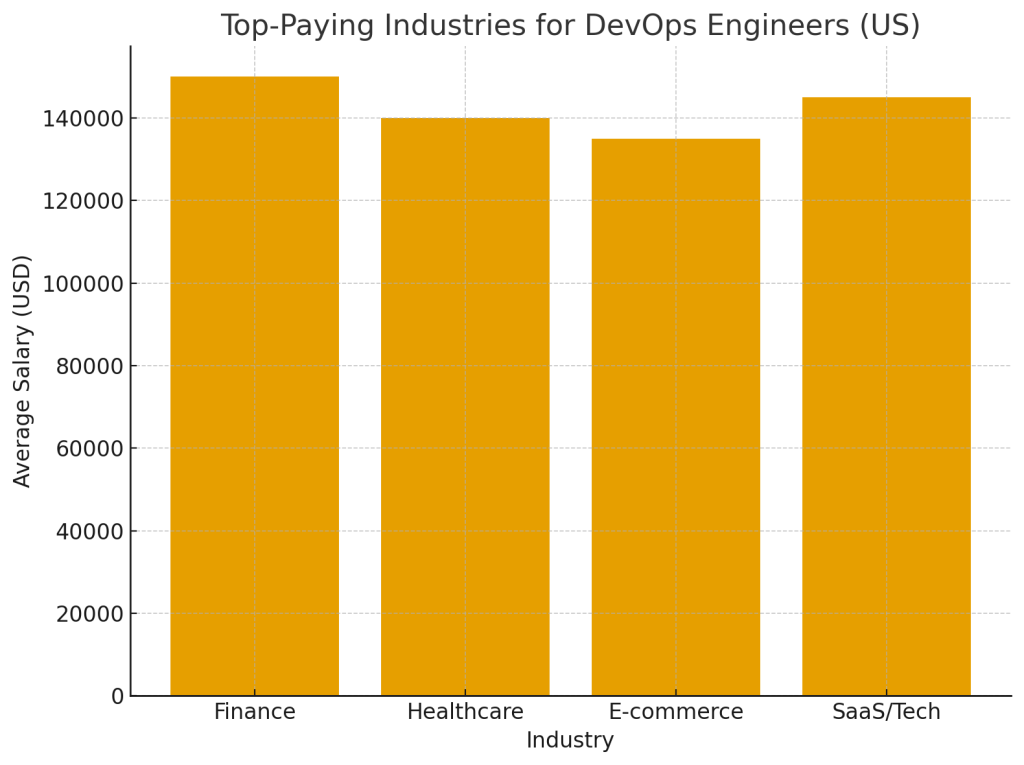
Not every industry pays the same. DevOps is valuable everywhere, but certain sectors are known for shelling out higher salaries:
- Finance & Banking: High security, strict uptime requirements — DevOps is mission critical here.
- Healthcare & Pharma: With digital health apps and patient data systems, reliability is priceless.
- E-commerce: Think Amazon, Flipkart, Shopify — they need 24/7 uptime and fast deployments.
- SaaS & Tech Startups: These companies live and breathe cloud, making DevOps talent one of their most valuable assets.
Career Path in DevOps
One of the great things about DevOps is that it isn’t a dead-end role. Once you’re in, you have multiple directions you can grow:
- DevOps Engineer: Your starting point — managing pipelines, cloud deployments, and automation.
- Site Reliability Engineer (SRE): A natural next step if you’re more focused on system reliability and large-scale operations.
- Cloud Architect: If you enjoy designing infrastructure and cloud strategies, this path is lucrative and highly respected.
- Engineering Manager: For those who want to lead teams and drive DevOps culture across organizations.
The bottom line? DevOps offers both financial growth and career flexibility. Whether you want to go deeper technically or move into leadership, the opportunities are there.
The Future of DevOps in the US
If you look at how the tech job market is shaping up in the US, one thing is clear: DevOps isn’t slowing down anytime soon. In fact, it’s evolving faster than most roles in tech. Companies across industries — from Silicon Valley startups to Wall Street banks — are doubling down on DevOps to stay competitive. Here’s where things are headed:
DevOps + AI/ML Automation
In the US, AI is becoming part of every conversation, and DevOps is no exception. American companies are investing heavily in AI-driven automation tools that can predict failures, auto-scale infrastructure, and even recommend fixes before an engineer touches the system. Think of it as “smart DevOps.” Instead of just monitoring dashboards, future DevOps engineers will be training and tuning AI models to keep systems reliable.
This shift means US-based DevOps roles will require not just scripting and pipeline knowledge but also a comfort level with data-driven automation. The upside? Less time firefighting, more time designing smarter, self-healing systems.
DevSecOps: Security-First by Default
The US has seen some of the costliest cyberattacks in history, which is why security-first DevOps (DevSecOps) is a growing priority here. Regulations like HIPAA (healthcare), PCI-DSS (finance), and FedRAMP (government systems) make it non-negotiable for DevOps pipelines to include automated security.
For engineers, that means tools like static code analysis, container security scans, and compliance-as-code will become daily tasks. If you’re in the US job market, highlighting security knowledge in your DevOps portfolio is going to set you apart.
Remote-First DevOps Teams
Another big trend in the US is the shift to remote-first DevOps. Since the pandemic, companies have realized they don’t need their engineers sitting in a Silicon Valley office to ship reliable software. In fact, many US firms now run globally distributed DevOps teams to ensure round-the-clock support.
For job seekers, this means opportunity is no longer limited to tech hubs like San Francisco, Seattle, or New York. Whether you’re in Texas, Ohio, or working from a small town, if you have DevOps skills, US companies are open to hiring you remotely. This also widens the market for people switching careers — you don’t need to relocate to start working in DevOps.
What This Means for Your Career
In the US, the future of DevOps is about smarter automation, stronger security, and remote-friendly collaboration. Companies are investing big in these areas, which means demand for skilled engineers will only grow. If you’re switching careers, this is a great time — the roles of tomorrow will be even more strategic, higher paying, and more flexible than they are today.
Why DevOps Is Worth the Switch
If you’re sitting on the fence about switching careers, DevOps is one of the safest bets in today’s US job market. Why? Because every industry — finance, healthcare, e-commerce, SaaS, even government — needs faster, more secure, and more reliable software delivery. That’s exactly what DevOps provides.
On top of that, the salaries are strong, the demand is only growing, and the flexibility to work remotely (or hybrid) makes it appealing for career changers who don’t want to uproot their lives. And unlike some tech roles that require years of coding experience, DevOps allows you to enter through a mix of technical and transferable skills — problem-solving, project management, and adaptability all count.
How to Get Started Today
Breaking into DevOps doesn’t mean quitting your job tomorrow and diving in blind. You can take it one step at a time:
- Start learning the basics: Linux, Git, and cloud fundamentals. Even a few hours a week can move you forward.
- Build a portfolio: Create small projects, automate tasks, or publish your pipelines on GitHub. Employers in the US love seeing real work, not just certificates.
- Network and connect: Join DevOps communities on LinkedIn, Slack, or Reddit. Attend local tech meetups if possible — many career switchers land their first role through networking.
The beauty of DevOps is that you don’t need to know everything to get started. Entry-level cloud or IT automation roles are often the best way in, and from there you can grow into full DevOps, SRE, or even Cloud Architect roles.
Frequently Asked Questions (FAQs)
1. Do I need to know coding to become a DevOps engineer?
Not deeply. You don’t need to build entire applications, but you should be comfortable writing scripts (Bash, Python) to automate tasks. Think of it less like “becoming a software developer” and more like “building glue that connects systems.”
2. Is DevOps the same as cloud engineering?
Not exactly. Cloud engineers focus on designing and maintaining cloud infrastructure, while DevOps engineers focus on how software is delivered, tested, and monitored. In practice, most DevOps roles require strong cloud skills, so the lines do blur.
3. How long does it take to get into DevOps from scratch?
If you dedicate consistent time, most career switchers take 6–12 months to land an entry-level DevOps or cloud-focused role. Those with some IT or development background can get there faster (3–6 months).
4. Which is the best cloud provider to learn first?
In the US job market, AWS dominates with around 32% market share. Azure is strong in enterprise-heavy states and Google Cloud is niche but growing. Start with AWS unless you’re targeting companies with a clear Microsoft stack.
5. Can DevOps roles be fully remote?
Yes. Many US tech firms and startups hire remote DevOps engineers because the work is tool-based and can be done from anywhere. Some jobs may still require occasional onsite visits for security or data center work.
6. What is the average salary of a DevOps engineer in the US?
According to Glassdoor and Indeed, DevOps engineers in the US earn $115K–$145K on average, with senior roles reaching $160K+. Location, certifications, and cloud expertise heavily influence pay.
7. Is DevOps stressful?
It can be—especially when production systems fail. But modern teams use automation, on-call rotations, and monitoring to reduce “firefighting.” The job is less about fixing chaos at 3 a.m. and more about preventing that chaos in the first place.
8. Do I need certifications to get hired?
Not mandatory, but helpful for visibility. Entry-level certs like AWS Certified Cloud Practitioner or Azure Fundamentals show commitment. Pairing a cert with a working project in your portfolio is far stronger than certs alone.
9. Will AI replace DevOps engineers?
AI is making pipelines smarter and automating repetitive tasks, but it still can’t replace the judgment, system design, and troubleshooting skills DevOps requires. Instead of replacing, AI will likely become another tool in your toolbox.
10. What’s the biggest beginner mistake in learning DevOps?
Trying to learn every tool at once. The winning path is to master a small project pipeline—GitHub → CI/CD → cloud deployment → monitoring—and only then expand into Kubernetes, IaC, and advanced observability.